
Theory & Process
Through our research, we have developed the Jensen reactor. The current model is the Jensen Reactor Mk I. We don’t add weird flavour extracts or synthetic elements. We alter the physicochemical state of the whisky. The key for good whisky is two things: extraction and transformation. The plot and the twist.
If you would like to dive deep into the chemistry of aged spirits, here you can check which compounds of interest we focus on during research.
EXTRACTION
At the beginning of the process previously used or new barrels are being disassembled. Next, whole barrel staves are loaded into the Jensen reactor, while other parts are chopped into chips and used in an ultrasound casket. We carefully select the types of barrels used for each product and are able to compose mixed sets of different barrel staves.
By the combination of ultrasound and heat exposure, we accelerate the extraction of precursors and flavour components as lignin, polyphenols, short and medium chained fatty acids, hemicellulose etc. Some components are important for the later transformation while others give direct flavour to the spirit.
TRANSFORMATION
The key flavour of aged whiskies are esters. Esters are formed by condensation of alcohol and organic acid (Carboxylic acid). The most abundant alcohol in whisky is ethanol and therefore most of the esters formed are ethyl esters.
However, other alcohols are also present in the spirit, they are collected from the tails fraction during the distillation process (butanol, propanol, amyl alcohols etc.). Additionally, depending on the distillate and the barrels, different organics acids are being extracted or created via chemical reactions.
The process of esterification depends on the type and strength of alcohol and organic acids. This is the beauty of aging, as the results vary so much depending on the quality of the barrel and the spirit.
Jensen reactor, while other parts are chopped into chips and used in ultrasound casket. We carefully select the types of barrels used for each product and are able to compose mixed sets of different barrel staves.
HOW DOES IT WORK?
Production begins with the careful selection of new make spirit, which forms the foundation of our future aged products. We work with craft, high-quality Scotch distillates and match them with precisely selected oak barrels.
It is important to understand that new make is not chemically “clean.” In addition to ethanol and water, it contains hundreds of congeners—compounds formed during distillation—that each contribute distinct properties and flavour profiles to whisky.
These include compounds desired by distillers—such as esters, aldehydes, and higher alcohols—as well as sulphur compounds and acids, which are generally undesirable. Starting with a high-quality base spirit allows us to focus entirely on maturation, the most critical step in whisky production.
Aging is what truly distinguishes raw spirit from finished whisky, driven by complex reactions between the distillate, its congeners, and the chemical components of the barrel wood.
Our reactor integrates multiple accelerated aging techniques into a single production unit. These include:
– elevated operational temperatures,
– high-frequency ultrasound,
– inorganic acid catalyst,
– custom-treated oak (or oak-alternatives),
– precise dissolved oxygen control,
– continuous liquid circulation with controlled flow rates,
– controlled headspace management and volatile compound capture, enabling angel’s share mimicry and recovery.
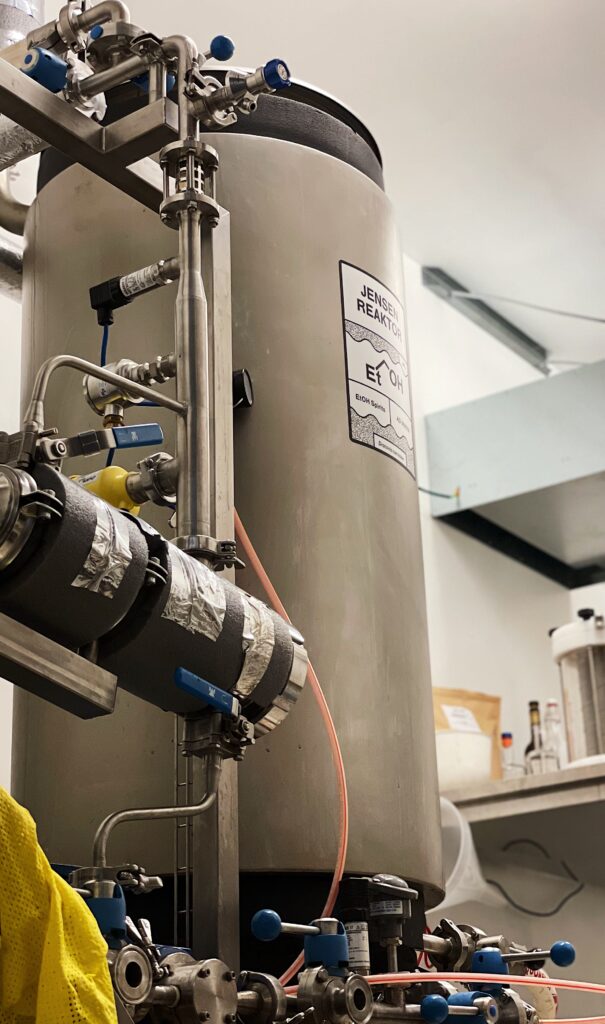
DIVING IN DEEP
Now, let’s dive deeper into what each of these parameters contributes to the final product:
Elevated temperature helps break down the wood’s cell walls, resulting in the release of higher amounts of soluble phenolics, colour compounds, and ellagic acid. In addition, increased temperature lowers the activation energy of chemical reactions, leading to significantly higher reaction rates.
Ultrasound introduces high-frequency sound waves that generate rapid pressure fluctuations within the liquid. These waves induce molecular vibration as they propagate through the medium. During the process, part of the energy is converted into heat, while the remainder produces cavitation. Cavitation plays a key role in enhancing oak extraction by intensifying mass transfer between the wood and the spirit.
Inorganic acid catalysis, like elevated temperature, reduces the activation energy of chemical reactions. More specifically, it increases the rate of one of the most important reactions in whisky production, esterification.
The use of custom-treated oak (or oak-alternatives) from real barrels enables significantly higher extraction of wood-derived compounds compared to traditional barrel aging over the same period.
Micro-oxygenation improves the spirit by supplying oxygen, a crucial component for many maturation reactions within the closed system. Operating in a closed environment limits uncontrolled oxygen exposure, while the deliberate addition of oxygen mimics the natural aging process.
An optimized flow rate ensures sufficient contact time between the wood and the spirit while maintaining proper mixing throughout production.
After 4 to 14 days of applying these parameters, the spirit is ready, resulting in a novel product shaped by controlled chemistry and precise process design.